Training Through Singapore’s Heat and Humidity: A Complete IPPT Guide
Last updated: 31 August 2026 | Written by Adrian Tan, IPPT Trainer and Fitness Content Specialist
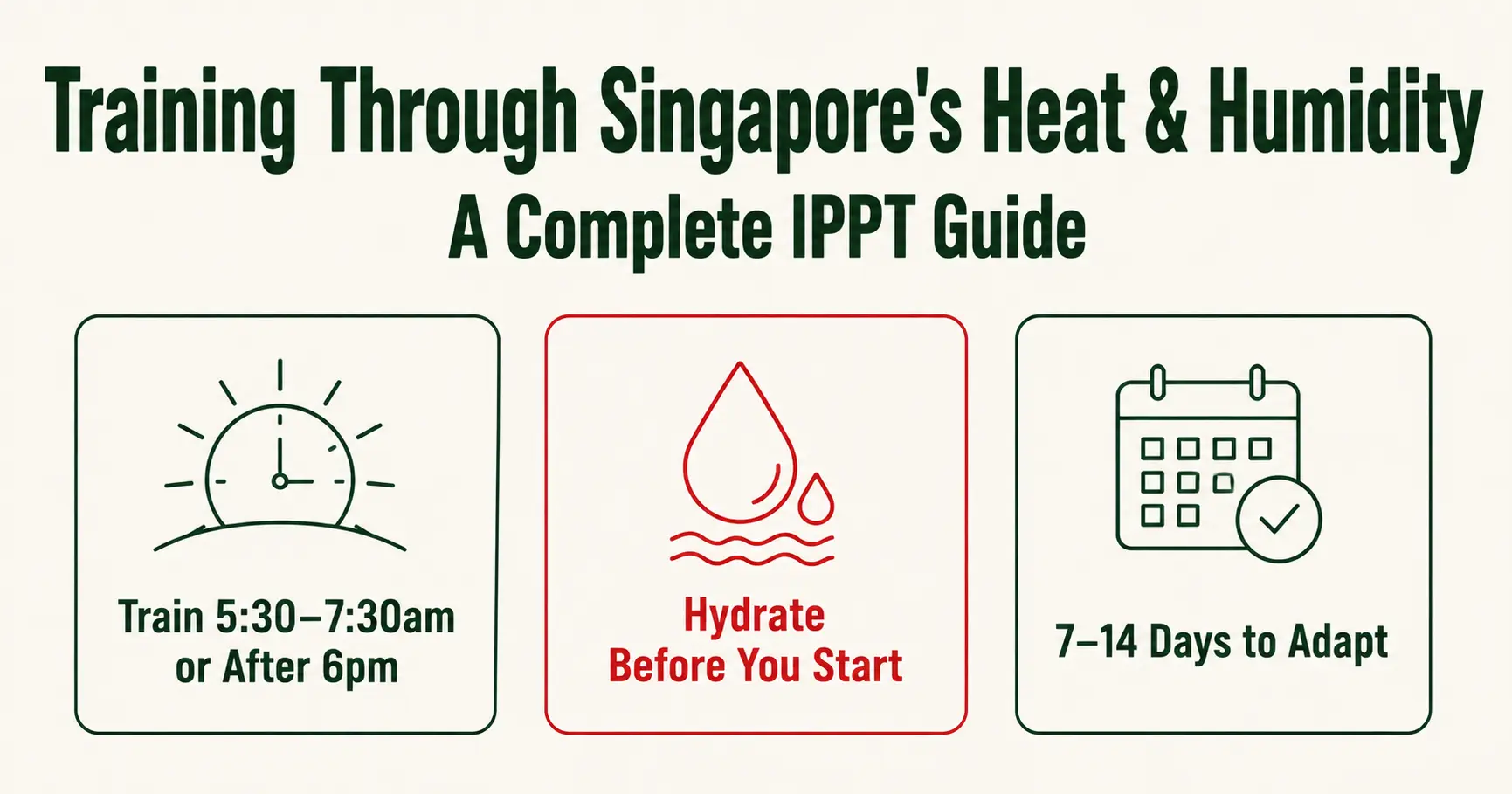
Train early morning, roughly 5:30am to 7:30am, or in the evening after 6pm to 7pm, to avoid Singapore’s peak heat and humidity. Stay well hydrated before you start, and give your body one to two weeks to adjust if you’re stepping up training intensity in hot conditions. That’s the short version; the rest of this guide covers why humidity is harder on your run than heat alone, and how to actually plan around it.
I’ve coached NSmen through more than a few sessions where someone shows up at noon, pushes for a personal best, and ends up nauseous halfway through the run. It’s almost always avoidable with better timing and pacing, not more willpower. Run your numbers through the IPPT score calculator to check where you stand, and keep an eye on conditions too, since haze season and IPPT training don’t always mix well.
Why Humidity Hits Harder Than Heat Alone
Your body’s main cooling system is sweat evaporation. In Singapore’s humidity, the air is often already close to saturated, so sweat sits on your skin instead of evaporating efficiently. That means your core temperature climbs faster than it would in a dry-heat environment at the same air temperature, and your heart rate drifts upward even at a pace that should feel easy.
This is why an 8km run in Singapore can feel like a genuinely harder effort than the same distance somewhere drier; it’s not just in your head, it’s a real physiological difference.
The Best Times to Train
Early morning, roughly 5:30am to 7:30am, is when temperatures are coolest and the sun is lowest. The next best window is after sunset, generally past 7pm. Avoid the stretch between 11am and 4pm: this is when heat and direct sun exposure are at their worst, with temperatures commonly reaching around 32°C.
If your only available slot is midday, shorten the session, ease your pace, and treat it as a lighter effort rather than a full-intensity run.
Hydration: What Actually Matters
Start every session already hydrated; don’t try to catch up mid-run. General sports-nutrition guidance suggests keeping fluid loss under 2% of your body weight during exercise, and replacing both fluids and electrolytes, particularly sodium, when you’re sweating heavily in hot, humid conditions.
If you notice visible salt marks on your cap or shirt after a run, you’re likely a heavier “salty sweater” and may need to pay closer attention to electrolyte replacement, not just plain water.
Give Your Body Time to Adapt
If you’ve been training indoors, or you’re stepping up your outdoor training intensity after a break, allow seven to fourteen days of gradually increasing heat exposure before pushing hard. Jumping straight into a full-effort 2.4km time trial in peak heat without this adjustment period raises your risk of heat exhaustion for no real pacing benefit.
Practical Adjustments for Hot-Weather Training
- Fabric choice: Moisture-wicking, non-cotton material helps sweat evaporate rather than trapping it against your skin.
- Route choice: Shaded routes and park connectors beat exposed roads or open fields; MacRitchie Reservoir’s tree canopy, for instance, offers noticeably more shade than East Coast Park or Bedok Reservoir.
- Pace by feel: Humidity adds real effort even at a familiar pace. Run by how you feel on a hot day rather than chasing your usual splits.
- Plan around water points: Know where you can refill along your route rather than carrying everything from the start.
If you’re looking for measured routes to train on instead, our free public running tracks guide covers six options across the island.
Frequently Asked Questions
Adrian Tan – IPPT Trainer & Fitness Content Specialist
Adrian Tan has worked hands-on as an IPPT trainer at a gym in Singapore, coaching NSmen and NSF through push-ups, sit-ups, and 2.4km run preparation, including pacing and hydration strategy in hot, humid conditions. This guide reflects general sports-nutrition and heat-training practices drawn from established sports-medicine sources; it is not medical advice. If you have a pre-existing health condition or experience symptoms like dizziness, confusion, or nausea during training, stop and seek medical attention.