Who Needs to Take IPPT: Eligibility and Exemption Guide
By Adrian Tan | Last updated: 16 November 2026
If you hold PES A, B1, B2 or C1, you must take IPPT every year. If you are permanently graded PES B3, B4, C2 or E, you are exempt. Officers stop at 45 years old, and warrant officers, specialists and enlistees stop at 40. That is the short answer, and the rest of this page shows you how to check your own case. In my gym, this is the question NSmen ask me most, usually two weeks before their window closes.
The 30 second check: must you take IPPT this year?
Work down this table. The first line that matches you is your answer.
| Your situation | Must you take IPPT? |
|---|---|
| PES A or B1, any rank, below the age limit | Yes |
| PES B2 | Yes, but you may be excused up to two static stations |
| PES C1 | Yes |
| PES B3 or B4, permanently graded | No |
| PES C2 or C9 | No |
| PES E, including E1 and E9 | No |
| Officer aged 45 or above | No |
| Warrant officer, specialist or enlistee aged 40 or above | No |
| Posted to MINDEF Reserve (MR) | No |
| PES D (pre enlistees only) | Not yet. Your grade is still pending |
This table follows the annual IPPT guidelines on the NS Portal, run by MINDEF. The NS Portal states the rule in one line: IPPT is a mandatory annual requirement for all eligible NSmen with PES A, B or B1 or B2 or C1 status. Everything below unpacks that one line, grade by grade.
If you must take the test, check your score first with our free IPPT calculator. It takes under a minute and needs no login.
What is PES, and why does it decide your IPPT?
PES stands for Physical Employment Standard. It is the medical grade CMPB gives you after your medical screening, and it is based on your medical condition.
Your screening sits at the Medical Classification Centre inside CMPB, opposite Cashew MRT station on the Downtown Line. CMPB is clear about what the grade does. The grade helps decide your vocation. If your PES changes with your health, your posting and your training change with it. The grade decides three things:
- Which vocations you can be posted to
- Which basic training programme you go through
- Whether IPPT is part of your yearly duty, and in what form
I just got my PES grade. Where can I see it?
Open the OneNS app or portal. Your current PES status sits in your profile, and that record is the one your unit and your FCC use. Do not plan from an old letter. If the record has changed since your last check, the new grade is the one that counts.
Every PES grade explained: meaning, vocations and IPPT
The grade bands below follow the CMPB PES page for the SAF. The SPF and SCDF use the same grade letters, with frontline operational wording in place of combat wording.
| PES grade | What it means in plain words | Vocation band (SAF) | IPPT? |
|---|---|---|---|
| A | Fully fit | All combat vocations | Yes |
| B1 | Fit, small limits that do not bar combat roles | Most combat vocations | Yes |
| B2 | Fit for some combat roles | Some combat and combat support vocations | Yes, up to two static stations may be excused |
| B3 | Below combat fit, limits on field duties | Some combat and combat support vocations | No |
| B4 | More limits than B3 | Some combat and combat support vocations | No |
| BP | Fit for the obese basic training programme | Regraded after that programme, based on a BMI review | Follows the new grade |
| C1 | Support fit, but still IPPT liable | Combat support band | Yes |
| C2 | Support fit | Some combat support and combat service support vocations | No |
| C9 | Support fit, wider limits than C2 | Some combat support and combat service support vocations | No |
| D | No final grade yet (pre enlistees only) | Decided after review | Not yet |
| E1 and E9 | Fit for service support work only | Combat service support and service vocations | No |
| F | Medically unfit for any form of service | None | No NS at all |
Read your own grade in detail below. Most men only need their own section.
PES A: what it means
You are fully fit, and every combat vocation is open to you: infantry, guards, commandos, naval divers, artillery and more. The grade also opens the widest set of postings inside the SPF and SCDF. If your medical record stays clean, this grade follows you through service. It is the baseline every pre enlistee hopes for, and the grade the system treats as the default.
PES B1 meaning: what changes, and what does not
PES B1 means you are fit for most combat vocations. In daily terms, almost nothing changes from PES A. You take the full IPPT, you train with your unit, and you keep the same pass mark. The difference sits in a few specialist courses, where a medical officer may want a second look before you start. Your vocation band is still the wide one, and most men with this grade never feel the limit.
PES B2: yes, you still take IPPT
This is the grade that catches people out. PES B2 men must take IPPT. The only relief is at the stations: CMPB states that PES B2 trainees are trained for IPPT but can be excused up to two static stations. Static stations are the push up and the sit up. The 2.4 km run is never excused, so your running still decides the result. Read the rule as a small adjustment, not an exit.
PES B3 and B4: exempt, once the grade is permanent
PES B3 and B4 men do not take IPPT. This is where the line sits: B2 and above take it, B3 and below do not. The grade must be permanent, and the key word is permanent. A temporary B3 or B4 grade, given while a review is still open, does not count. Check your OneNS record, not your memory of a letter from two years ago.
An ask.gov.sg answer from MINDEF puts the same rule from the other side: NSmen who are PES B3 or B4, or PES C2 and below, are exempted from the IPPT programme. If your grade is B3 or B4 and it is permanent, the test simply does not apply to you.
PES C1: the trap grade
Read this twice if it applies to you. The C in C1 makes men assume the whole C band is exempt. It is not. PES C1 men take IPPT, with a modified test that matches their medical limits. Your unit will tell you which stations you take, and your pass mark follows the modified table. Do not skip your window because of the letter C. Check the NS Portal list, where C1 sits with A, B1 and B2 as liable grades, not with the exempt grades.
PES C2 and C9: exempt, and still serving
PES C2 and C9 men are exempt from IPPT. CMPB places both grades in the same band: some combat support vocations, and combat service support vocations in the SAF. The difference is the review. C2 is a settled grade, given after a full review. C9 is a temporary grade, given while a condition is still being assessed. While you hold either grade, you do not take IPPT, and you do not book a window.
PES D: pending, not exempt
PES D applies to pre enlistees only. CMPB defines it as temporarily unfit for grading and pending further review. More time or tests are needed before a final grade can be set. While you hold PES D, you do not take the pre enlistee IPPT, and you do not enlist. Your enlistment waits for the review, and your final grade decides what happens next.
PES E: office hours are still NS
PES E, in its E1 and E9 forms, means combat service support and service vocations in the SAF: clerks, storekeepers, drivers and other office based roles. The grade is permanent unless a review board changes it. You are exempt from IPPT, and you are exempt from field training. Your service is still full time, and your ORD date still counts.
PES BP and PES F: the two ends of the list
PES BP is not a final grade. It sends a recruit into the obese basic training programme, and he is regraded after it, based on a BMI review. PES F is the other end: a man graded F is medically unfit for any form of service, and he does not serve. If you hold BP, your grade will change. If you hold F, your NS journey ends before it starts.
New to the whole topic? Start with our guide to what IPPT is, then come back here with your grade in hand.
What vocations can your PES grade get?
This is the second question every pre enlistee asks, right after the IPPT one. The honest answer has two parts. First, your grade opens a band of vocations, not a single job. Second, your exact post is decided later, after your BMT, your interests and your unit’s needs. CMPB publishes bands, not job lists. Your grade opens a band of vocations. Your exact post is decided later.
| PES band | Vocation band in the SAF | Vocation band in the SPF and SCDF |
|---|---|---|
| A and B1 | All combat vocations | All frontline operational vocations |
| B2, B3 and B4 | Some combat vocations, and combat support vocations | Some frontline operational vocations, and frontline support vocations |
| C2 and C9 | Some combat support vocations, and combat service support vocations | Some frontline support vocations, plus service support in the SPF |
| E1 and E9 | Combat service support and service vocations | Administrative support vocations |
So treat any forum post that promises an exact vocation from a grade alone with care. Nobody outside CMPB can promise you a posting. Your grade opens a band, and the posting follows later.
What vocations can PES B1 get?
Most combat vocations are open: infantry, guards, armour, artillery, combat engineers and other frontline posts. The band is wide, and the exact post follows your BMT results, your interests and the needs of the service.
What vocations can PES C9 get?
Combat support and combat service support posts: supply and logistics work, transport, maintenance support and other service roles. The work is real, and the training is real. A C9 grade changes the shape of your service, not its value.
Who must take IPPT, group by group
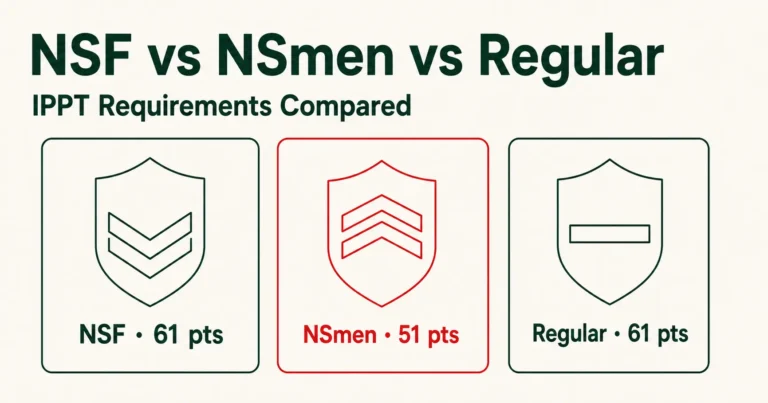
Your PES grade is only half the answer. The other half is your group. The same grade means different things for an NSman, an NSF, a Regular and a pre enlistee. Read the heading that fits you.
NSmen: the yearly window rule
You must attempt and pass IPPT every year, in the window your birth month sets. Your window opens on the first day of your birth month and closes at the end of the following month. A January birthday gives a January and February window. Miss it and your unit will know. Complete the test, or the remedial training, inside that window.
One more case belongs here. Some NSmen hold a PES grade that exempts them from IPPT but still owe their unit a yearly visit. They do not book an FCC slot. They report for duty as their unit directs, and their exemption is recorded, not argued, at the gate.
NSF: full time, same stations, higher pass mark
You take IPPT as part of your full time service, and your unit will schedule it for you. The pass mark is the same, and the stations are the same. The difference is the setting: you train for it every day, and your commanders track your result as part of your unit’s readiness. A pass is expected, not celebrated.
Regulars: IPPT is part of the job
A Regular takes IPPT as part of the job, and the result sits in the annual appraisal. The pass mark follows your age group, and the stations follow your PES grade. A Regular who cannot pass will be given remedial training and a second chance. A Regular who passes well will see it in the record.
The female scoring tables sit on our Female IPPT Standards page.
Pre enlistees: a different test with a different prize
A pre enlistee takes the pre enlistee IPPT, and the result can shorten the wait before enlistment. The test is voluntary, but the result is real. It can move your enlistment date earlier, and it can open a posting you want. Book it early, while you are still training for it.
Boys in the other grades take the test that matches their grade. A PES B2 boy takes the full test, with the static station relief. A PES C1 boy takes the modified test. A PES B3 or B4 boy does not take it at all.
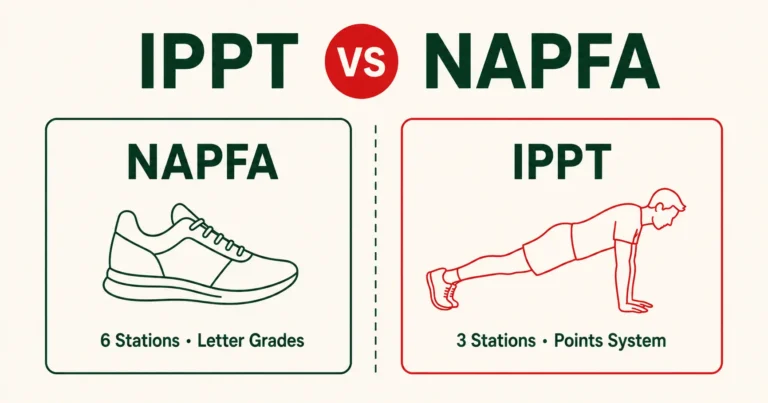
A school route leads to the same result. The NAPFA test in school feeds into the same system, and a strong NAPFA result can shorten the path. Check with your school, and treat the result as a head start, not a holiday.
When does IPPT stop? Age limits and MINDEF Reserve
| Stop point | Who it covers |
|---|---|
| IPPT duty ends at 40 | All NSmen and Regulars, unless the next row applies |
| IPPT duty ends at 39 plus 1 | MINDEF Reserve NSmen, who are posted to MINDEF Reserve after 10 years of service |
| IPPT duty ends at 45 | Officers, and Regulars in the senior grades |
| IPPT duty ends at 40 for officers and 45 for other ranks | Home Team NSmen in the SPF and SCDF |
Note the split. An NSman who turns 40 in a given year takes his last IPPT that year, in his window. The year after, he is out. The 39 plus 1 case is the odd one: a man who moves to MINDEF Reserve after 10 years of service takes one more test, in the year he turns 40. Read the row that fits you, not the row that fits your friend.
Home Team NSmen sit outside the MINDEF rules. Police and SCDF NSmen follow their own force rules, and the ages differ. Check your own force’s instruction, not a MINDEF one.
Crossing the limit ends the duty, not the service. You still turn up for ICT, you still serve, and you still answer to your unit. The yearly test simply stops.
My birthday is inside my window. Which age counts?
Your IPPT age is the age you turn in the calendar year of the test. If you turn 40 in December, your age for the whole year is 40, and your last test is in your window that year. Your birth month sets your window, and your birth year sets your age. The two rules work together, and they never conflict.
The 2026 update pre enlistees must know: PES is being replaced
If you are enlisting from October 2027 onwards, your PES grade will come from a new test. MINDEF is replacing the current PES system with a Modular Cause System, or MCS. The change has been in the works for some years, and the first pre enlistees under it will see their grades change. The test will be different, and the letters may change. The principle will stay the same: a grade that sets your physical envelope.
- The letters may change, but the idea will not: a grade that sets your physical envelope.
- Your IPPT duty will still follow your grade, whatever the letters say.
- Your vocation band will still follow your grade, whatever the letters say.
Under the MCS, your medical screening will look at your conditions in a different way. The system will group them into modules, and each module will set a limit. Your grade will follow from the modules, not from a single letter. The change is a new way of describing the same body.
What does this mean if you hold a PES grade today? Nothing, for now. Your grade stands, your IPPT duty stands, and your vocation band stands. The new system applies to new pre enlistees, not to men already in service. When your next review comes up, your grade will be set under the new system, and your duty will follow the new grade.
Must you take it? Then know where the test happens
IPPT for NSmen runs at the Fitness Conditioning Centres, the FCCs. There are four of them, and they are the only places that run the test. You book a slot, you turn up, and you take the test in the same order every time. The stations are the same, the timing is the same, and the result is posted the same day.
Once you know you must take it, see how to book IPPT on OneNS for the step by step OneNS booking, deadlines and FCC session timings.
Local detail that saves a wasted trip: the FCCs sit at Bedok, Khatib, Kranji and CMPB, and each one has its own opening hours. Book the centre that suits your travel, not the one your friend uses. The test is the same at all four.
Centre addresses, opening patterns and booking notes sit in our FCC guide.
Mistakes I see every year, as a trainer
I run a gym now, and I train NSmen, NSF and pre enlistees for IPPT. The same five mistakes come up every year, and they cost men their window, their pass or their money. Read them once, and do not repeat them.
- Waiting for the last week of the window. The FCC slots fill up, the queues grow, and the pressure builds. Book early, and train early.
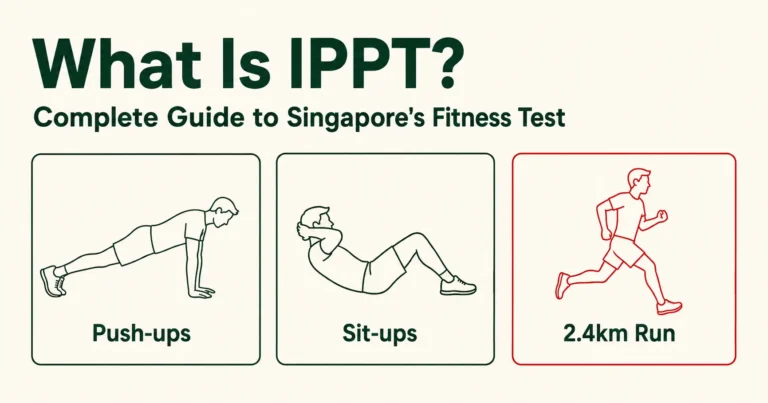
- Training only the run. The run is one station out of three. The push up and the sit up are the stations that fail men, because they never train them. Train all three, every week.
- Ignoring the medical letter. If your grade has changed, your IPPT duty has changed with it. Check your OneNS record before you book, not after you fail.
- Skipping the warm up. A cold start costs points, and it costs injuries. Arrive early, warm up, and take the test with a body that is ready.
- Chasing a score, not a pass. The pass mark is the line that matters. A pass is a pass, and the award is a bonus. Train to pass first, then chase the award.
Frequently Asked Questions
Adrian Tan is an IPPT trainer and fitness content specialist. He previously trained clients at a commercial gym in Singapore and now runs his own gym, where he trains NSmen, NSF and pre enlistees for IPPT.