Medical Exemption and MC Guide for IPPT
By Adrian Tan | Last updated: 17 November 2026
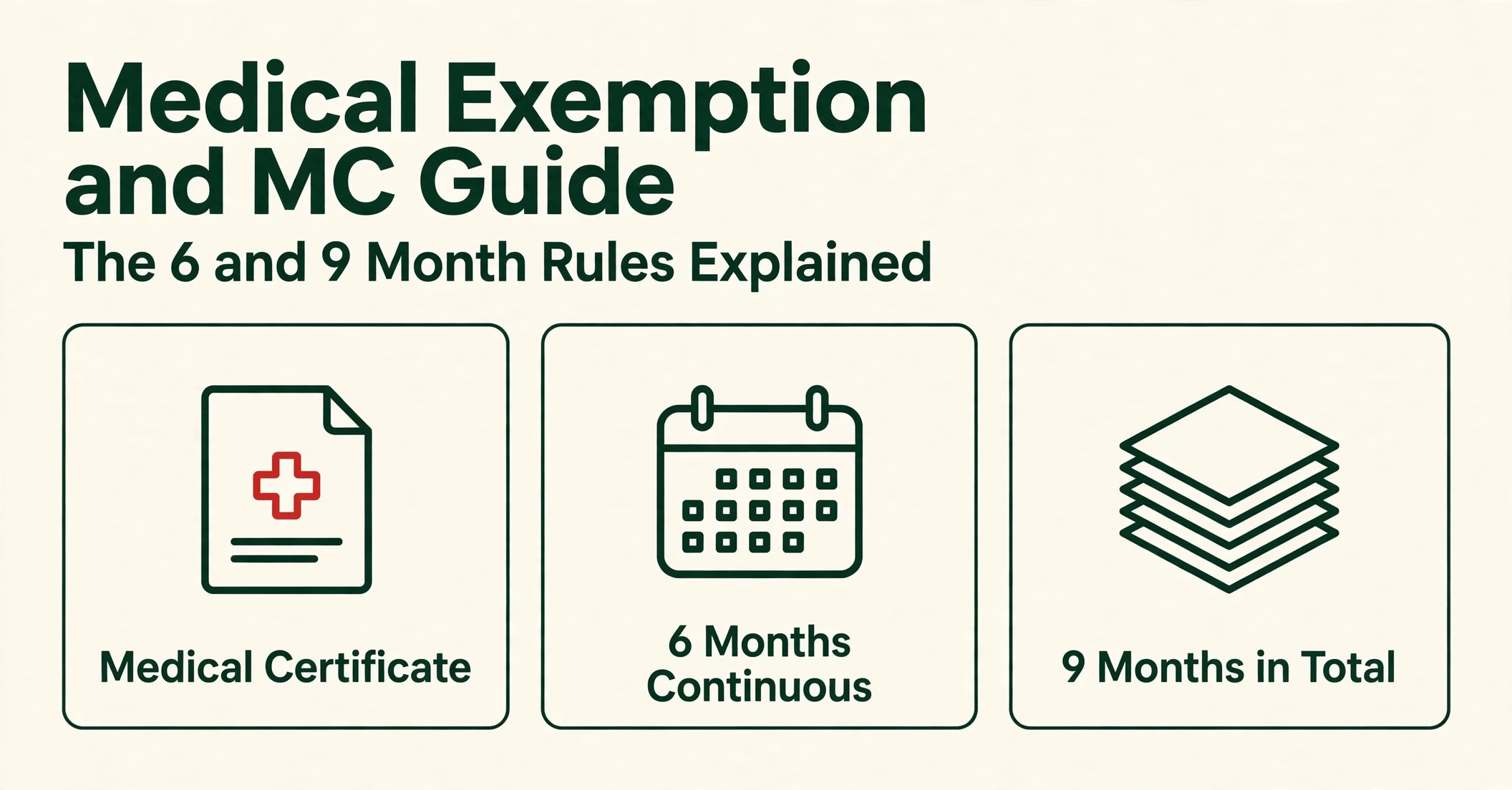
A medical excuse closes your IPPT window only when it covers 6 months continuously, or 9 months in total, inside that same window. Anything shorter leaves the duty in place, no matter how real the injury is. And an MC from your own doctor only counts once your unit Medical Officer has endorsed it through a medical review booked on OneNS. I train men who learned both of these rules the hard way, at a Summary Trial. This page is here so you learn them here instead.
What exempts you from IPPT, and what does not?
| Your medical situation | Does it close your IPPT window? |
|---|---|
| MC or excuse of a few days or weeks | No. It excuses you while it runs, then the duty is still there |
| Excuse of 3 months, for example during SAF Health Screening | No |
| 6 months of continuous medical excuse inside the window | Yes, for that window |
| 9 months of medical excuse in total inside the same window | Yes, for that window |
| Excuse period that straddles across two windows | No. It exempts you in neither window |
| Permanent medical downgrade recorded for you | Yes, the yearly duty ends (see the eligibility guide on this site) |
| Excuse from one or two static stations only | No. You still take the rest of the test, and the 2.4km run always stands |
The rules behind this table come from ask.gov.sg, where MINDEF answers these exact questions one by one. The rest of this page walks through each line, and the steps that make an excuse count.
What is the 6 and 9 month rule?
MINDEF states the rule the same way in several of its official answers. In its own words on ask.gov.sg, an exemption needs “6 months continuous or 9 months cumulative medical exemption within the IPPT window”. Nothing shorter closes the window.
Read that rule slowly, because men trip on three separate parts of it.
- Continuous means unbroken. Six months of excuse that runs in one stretch, with no gap where you were fit again.
- Cumulative means added up. Shorter excuse periods inside the same window can be added together, but they must reach 9 months in total. That is a very long time to be excused inside a 12 month window, and it is meant to be.
- Within the window means within. The months are counted inside one IPPT window. They do not carry into the next one.
My excuse period straddles two windows. Does it count?
No. MINDEF answers this exact question on ask.gov.sg: if your 6 months continuous or 9 months cumulative medical excuse straddles across two IPPT windows, you will not be exempted from your annual IPPT requirement for both windows. A long excuse that starts near the end of one window and runs into the next one can leave you short in both. If that is your case, talk to your unit early. Waiting quietly is the worst move available to you. Where one window ends and the next begins decides cases like this, and our IPPT window guide sets out those dates and how extensions and medical cases are treated.
Why a short MC does not exempt you
An MC is a valid excuse. It is not an exemption, and mixing the two up is where the trouble starts.
MINDEF is direct about the first part: the Medical Certificate your doctor issues is recognised as a valid medical excuse. If you are injured or medically unfit during your window, you are advised to seek medical treatment, and your MC is the proof of that. While the MC runs, you are excused. Nobody expects a man with a fresh injury to report for a 2.4km run.
But the window does not close behind the MC. When the MC ends, the window is still open, the duty is still yours, and the test is still waiting. A two week MC buys you two weeks of rest. It does not buy you the year. Men get this wrong because the word excuse feels final. All it gives you is a pause while you recover.
I was excused for 3 months. Surely that is enough?
It is not, and MINDEF has answered this one in writing too. Men who were excused from IPPT or NS FIT for 3 months during their SAF Health Screening Programme asked if they were exempted. The answer: no, and a man who then does not complete his IPPT or NS FIT will be deemed a defaulter. Three months is a long time to be unwell. It is still half of the shorter threshold. The rule does not grade on effort. It counts months.
How to submit an IPPT excuse so that it counts
This is the section that protects you. An excuse that the system cannot see is an excuse that does not exist, and the fix is a short official route.
MINDEF sets out the route on ask.gov.sg: to submit an IPPT excuse, you are required to book a medical review appointment with your unit Medical Officer to obtain an official excuse status, and you do that through the Manage Medical (eHealth) eService on OneNS. For an injury inside your window, the same answer adds the point men miss: book the review so your medical excuse gets endorsed by your unit MO.
In working order, the steps are:
- Get treated first. See your doctor, and keep the MC he issues. That MC is recognised as a valid medical excuse, but it is still a piece of paper in your drawer at this point.
- Book the medical review on OneNS. Open the Manage Medical (eHealth) eService and book a medical review appointment with your unit MO. Do this while the MC is current, not after your window closes.
- Bring your documents. Take the MC and any specialist letters or reports with you. The MO works from documents, not from memory.
- Get the endorsement recorded. The outcome you need is an official excuse status recorded for you, with dates. If it is not recorded, it did not happen, whatever was said in the room.
- Check it afterwards. Your exemption status can be checked through your unit S1, Personnel Centre or S8, or through the same Manage Medical (eHealth) eService on OneNS. Check it the week you get it, not the month your window ends.
Do I need to inform my unit, or is the MC enough?
Inform your unit. The onus sits on you, in MINDEF‘s own framing, and an MC sitting in your phone gallery informs nobody. Book the review, get the status recorded, and tell your unit what is going on while there is still time in the window to act on it. Units can work with a man who reports a problem in month two. They can do very little for a man who surfaces in the last week with a folder of old paper.
Not sure whether you even hold an IPPT duty this year? Start with our guide to what IPPT is, then come back to this page if a medical issue is in the way.
Can you be excused from just one station?
Not every medical problem closes the whole test. Medical exemptions, in MINDEF‘s definition, are issued by Medical Officers to set out a serviceman’s eligibility to take part in specific activities, based on a medical assessment. For IPPT itself, MINDEF answers the question “Can I be exempted from one station?” on ask.gov.sg with a hard limit: an SAF Medical Board may grant medical exemptions for up to 2 IPPT stations, less the 2.4km run. In plain terms, a partial exemption covers the static stations only, push ups and sit ups, up to a maximum of two, permanent or temporary. The run is never partly excused. You take it, or you hold a full Exempt IPPT status. To ask for a station exemption, make an appointment with your unit Medical Officer.
The pass mark moves when a station drops away. With one static station exempted, you pass with more than 39 points from what is left. With both static stations exempted, you pass with more than 26 points, which means your run has to carry you. And there is a cost men learn about late: an NSman who is exempted from any static station is not eligible for the monetary incentive awards, even when he passes. MINDEF sets out those numbers on ask.gov.sg as well. Two things follow from all this. First, a station exemption is not a window exemption, and the 6 and 9 month counting above does not turn it into one. Second, what you are excused from must be recorded before test day. The FCC works from the record in the system, so an unrecorded problem earns you nothing on the day, however real it is.
The MO gave me an excuse. Why am I still charged as a defaulter?
Because the charge is not about whether you were excused. It is about whether your excuse met the exemption bar. This is the most painful question in this whole topic, and MINDEF answers it on ask.gov.sg in almost these words: the onus of taking IPPT is on the individual, so you should be able to work out whether the period of your MC or medical excuse met the criteria for medical exemption, that is, 6 months continuous or 9 months cumulative. If it did not meet the criteria, you will be deemed a defaulter.
The process from there is formal. A notice of summons is issued, and you attend a Summary Trial, where you get the opportunity to present all relevant medical certificates to the Disciplinary Officer. Read that last part again, because it is the one piece of good news in this section: your MCs still speak for you at the trial, even when they were not enough to exempt you. Keep every MC, every memo and every report, in date order, from the first day. Paper you kept is a defence. Paper you threw away is a regret.
I am a trainer, not a lawyer or an MO, and this page does not argue your case for you. It tells you where the line sits so you do not cross it by accident: count your excuse months honestly, inside one window, against 6 and 9. If the count falls short, the duty stands, and the time to fix things is while the window is still open.
How a medical review works, and where a downgrade comes from
If your problem is not a two week problem, the route is a medical review. Men ask me for the shortcut version of this every year, so here is the honest version: there is no shortcut, there is a queue, and the queue moves on documents.
MINDEF sets out the NSman route on ask.gov.sg: book a medical review appointment for a consultation at the SAF Medical Centre, bring any relevant documents with you, and the Medical Officer will evaluate your case and follow up as required. As listed on ask.gov.sg, appointments run through the Medical Teams: West on 6373 1525 or 6373 1306, and East on 6510 0966 or 6510 0964. Check OneNS for the current route before you call, because numbers and booking channels change.
At the review, one of three things tends to happen. The MO records an excuse status for a set period. Or the MO needs more proof, such as a specialist report or investigation results, and sends you to get it. Or the case is bigger than a review can settle, and it goes one level up, to a Medical Board.
What is a Medical Board, and can I book one?
A Medical Board is the body that makes the grading decision. MINDEF describes its work on ask.gov.sg: the board is convened to evaluate a serviceman’s medical condition, and its jobs include reviewing his PES grade and deciding questions of permanent disability after service injuries. Two facts about the board save men a lot of wasted effort:
- You cannot book a board yourself. Medical Board appointments cannot be made through eHealth. A board is set up by a Medical Officer, and only when your medical information is complete and all investigation results are back.
- A medical review comes first, by design. The review lets your unit MO gather what the board needs, specialist reports and investigation results, so the board can decide. Depending on how complex the condition is, more than one review may be needed before the board sits.
- Not every case reaches a board. A temporary PES status of less than 12 weeks does not need a Medical Board review, provided you can keep working in a restricted capacity. In that case an MC is issued that spells out the disability or the limited deployment.
You may choose to be present or absent at your own board. Either way, the board decides on the documents. That is why the paper trail in the sections above matters more than anything you can say on the day.
How long does a review take?
There is no single official number that covers every case, and any site that gives you one is guessing. MINDEF has not published a general timeline for these reviews. The honest picture from the official answers is this: simple cases settle at a single review, and cases that need specialist reports or a board take longer, because each round waits on documents and results. Plan on weeks rather than days, and start early enough that a slow review does not eat your window.
Is your excuse temporary, or a permanent downgrade?
These two get mixed up constantly, and the mix up is expensive, because they behave in opposite ways.
| Temporary medical excuse | Permanent downgrade | |
|---|---|---|
| What it is | A recorded excuse status for a set period, tied to your current condition | A recorded change to your medical grading itself |
| How you get it | Medical review with your unit MO, booked on OneNS eHealth | Medical Board decision, after one or more medical reviews |
| Effect on this window | Counts toward the 6 and 9 month rule, inside this window only | Ends the yearly IPPT duty from the point it is recorded |
| Effect on the next window | None. A new window starts with a clean count | The duty stays ended while the grade stands |
| What ends it | The dates on the status, or a later review | A later review or board that changes the grade again |
One line from the eligibility rules ties this table to the rest of the site: the downgrade ends the IPPT duty only when it is permanent and recorded. A man who has been told he is likely to be downgraded, but whose board has not sat yet, still holds his duty and his window. Hope is not a status. The record is the status.
Traps I see every year, as a trainer
- The drawer full of MCs. A man collects MCs all year and submits none of them. At the end of the window he owns a stack of valid paper and not one recorded excuse. Submit as you go.
- The verbal promise. An MO says kind words about a likely downgrade, the man hears a decision, and stops watching his window. Boards decide. Words in a consultation room do not.
- The straddle surprise. A long excuse crosses the window line and the man assumes it covers both years. It covers neither, by the official answer. If your excuse is heading toward the boundary, talk to your unit before you cross it.
- The last month panic. Reviews, endorsements and boards all run on appointments and documents. None of them can be rushed into the final fortnight of a window. The time to start is the week you get hurt.
- Training through it quietly. A man keeps training on an injury so he does not fall behind, and turns a six week problem into a six month one. Get treated, get the MC, get it recorded. Fitness comes back. A defaulter record is stickier.
Frequently asked questions
Adrian Tan is an IPPT trainer and fitness content specialist. He previously trained clients at a commercial gym in Singapore and now runs his own gym, where he trains NSmen, NSF and pre enlistees for IPPT.