IPPT vs NAPFA: What’s the Difference?
By Adrian Tan, IPPT Trainer & Fitness Content Specialist | Last updated: 18 November 2026
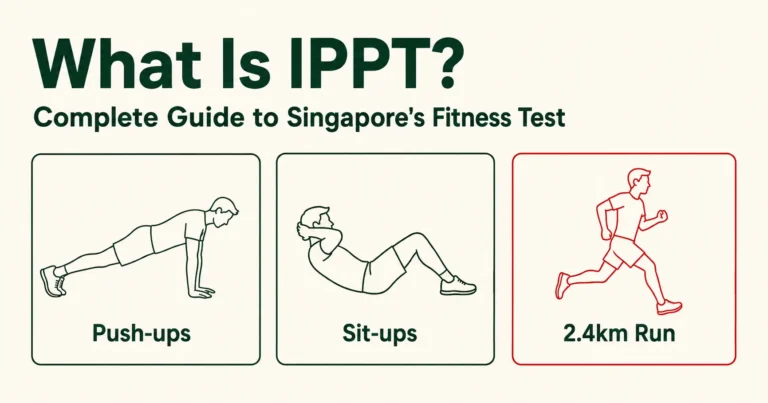
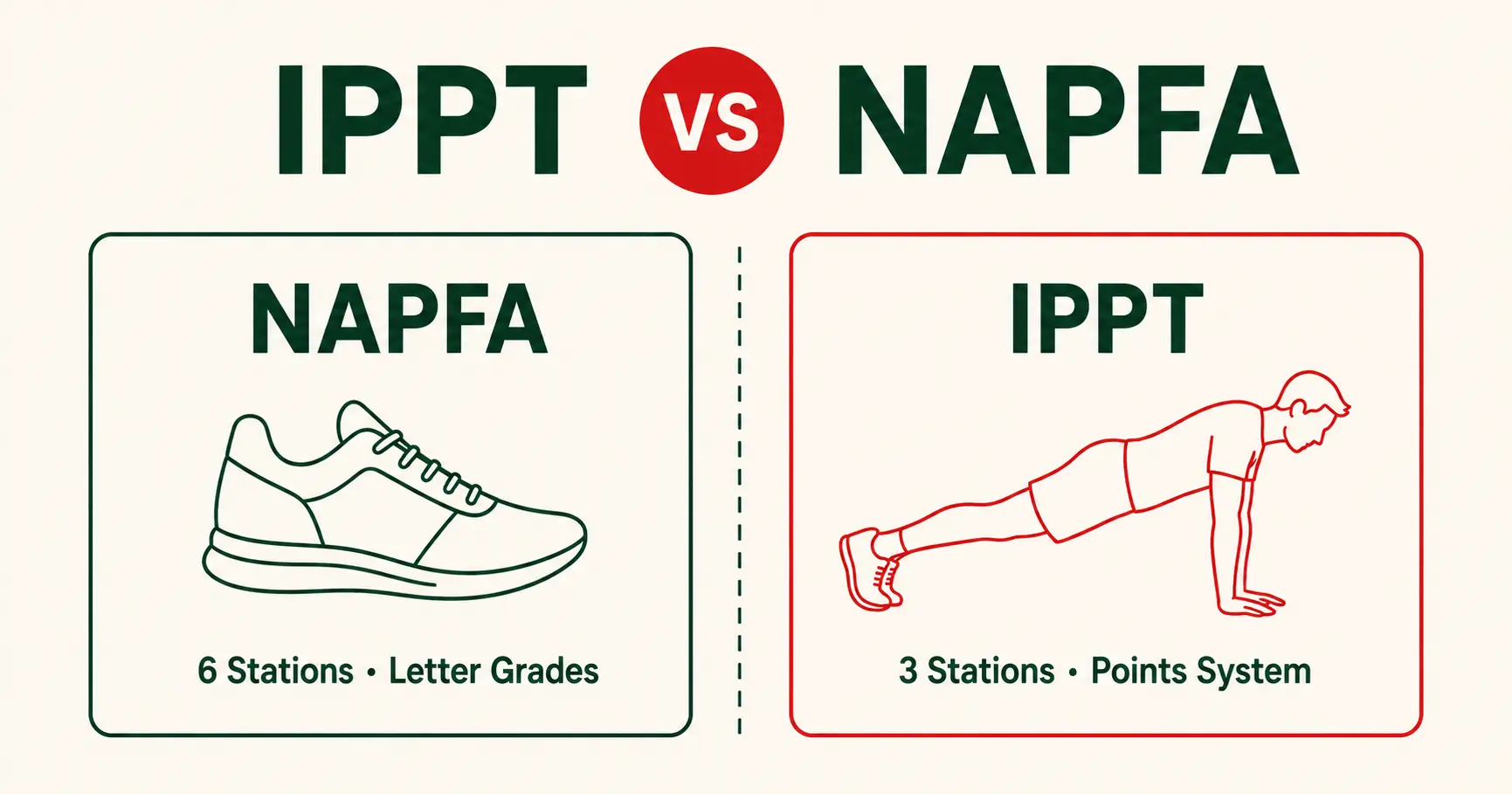
IPPT vs NAPFA is a comparison I explain every enlistment season, because these are two separate fitness tests. NAPFA is run by the Ministry of Education for students from Primary 4 through JC2, uses 6 stations, and grades performance with letters. IPPT is run by MINDEF for National Servicemen, uses 3 stations, and scores performance with points. Your school NAPFA grade does not become your IPPT score, since the two systems measure different things in different ways. There is one exception, though, the modified NAPFA for students in a JC, MI, polytechnic or ITE, and it matters if you are about to enlist.
Why Do People Confuse IPPT and NAPFA?
I get this mix-up all the time from guys who just enlisted. They walk in expecting the same six-station test they did in school, and it throws them off when IPPT only has three. It’s an understandable mistake since both tests measure fitness in Singapore and both use a 2.4km run as the final station, but they were built for different purposes and by different government bodies.
NAPFA stands for the National Physical Fitness Award. It’s designed to give a broad, general assessment of a student’s health and performance-related fitness across childhood and adolescence. IPPT exists purely to check combat readiness for men with NS liability. One is an educational fitness benchmark. The other is a military standard.
Side-by-Side Comparison
| NAPFA | IPPT | |
|---|---|---|
| Governing body | Ministry of Education (MOE) | MINDEF (SAF, SPF, SCDF) |
| Who takes it | Students, Primary 4 to JC2 | NSFs, NSmen, Regulars |
| Number of stations | 6 | 3 |
| Scoring format | Letter grades (A to F) per station | Points (0 to 25 or 0 to 50) per station |
| Award levels | Gold, Silver, Bronze | Pass, Pass with Incentive, Silver, Gold |
| Cash incentive | None | $200 to $500 |
| Purpose | General student fitness assessment | Combat readiness assessment |
Station by Station: What’s Different?
Here’s where the two tests genuinely diverge. NAPFA tests a wider range of physical qualities, including flexibility and explosive power, that IPPT doesn’t touch at all:
| NAPFA (6 stations) | IPPT (3 stations) |
|---|---|
| Sit-ups (1 minute) | Sit-ups (1 minute) |
| Standing Broad Jump | No equivalent |
| Sit and Reach | No equivalent |
| Pull-ups or Inclined Pull-ups | No equivalent |
| 4x10m Shuttle Run | No equivalent |
| 1.6km or 2.4km Run | 2.4km Run |
| No equivalent | Push-ups (1 minute) |
Standing Broad Jump and the 4x10m Shuttle Run measure explosive leg power and agility, both dropped entirely from IPPT. Sit and Reach measures flexibility, also absent from IPPT. Pull-ups test upper body pulling strength, replaced in IPPT by push-ups, which test pushing strength instead. If you were strong at pull-ups in school but never trained push-ups specifically, don’t assume that strength transfers directly. The movement pattern is different enough that it genuinely needs its own practice.
How Is NAPFA Graded Compared to IPPT?
NAPFA uses a letter grade system per station (A through F), then converts those grades into an overall point total for Gold, Silver, or Bronze:
| Award | Points Needed | Minimum Grade Per Station |
|---|---|---|
| Gold | 21 or more | C in every station |
| Silver | 15 or more | D in every station |
| Bronze | 6 or more | E in every station |
A student who scores B, A, C, C, B, A across the 6 stations earns 24 points total, which is Gold, since every station meets at least a C grade. IPPT skips the letter grade step entirely and scores reps and time directly into points, out of 25 for push-ups, 25 for sit-ups, and 50 for the run.
For the exact push-up, sit-up, and run point breakdown used in IPPT, see the IPPT Age Group & Scoring Standards guide, which lays out the age-banded point tables in full.
When Was NAPFA Introduced?
NAPFA has been around since 1982, first rolled out at the secondary and pre-university level, then extended down to primary school in 1992. IPPT itself traces back further, though its current 3-station format only dates to 2015. Before that, IPPT ran on a 5-station format from 1979 onward. Both systems have gone through their own separate rounds of change, which is part of why the two get mixed up even though they’ve never actually been the same test.
IPPT vs NAPFA: Does NAPFA Affect My IPPT in Any Way?
Directly, no. Your ordinary school NAPFA grade has no bearing on your NSF or NSmen IPPT score, because the two tests use different stations and different scoring. In my training work I see this confusion every year, so let me separate the school test from the one exception that does count in any IPPT vs NAPFA comparison.
That exception is the modified NAPFA. If you took it at a JC, Millennia Institute, polytechnic or ITE, your results for the three IPPT stations are transmitted to CMPB and they count as your Pre-Enlistee IPPT, so you do not sit that test again on your own. This is the real link between the two tests, and it matters before enlistment.
It only helps with Physical Training Phase if every condition is met in full. You need a PES A or B1 grading, 61 points or more, and at least 1 point at every station, and that 61 must be scored at least 2 weeks before your enlistment date. Meet all of that and your Physical Training Phase is shortened by 8 weeks. Miss one condition and you train for the Pre-Enlistee IPPT as its own target, which is how I coach my pre enlistees.
I’m a Student, Not NS Liable Yet. Do I Need to Worry About IPPT?
Not until you enlist. If you are currently in secondary school, JC, or polytechnic, NAPFA is your relevant test for now. Once you are preparing for enlistment, the test that matters is the Pre-Enlistee IPPT, which uses the same scoring system covered in our full IPPT guide, not the NAPFA system you are used to. If you took the modified NAPFA test at a JC, Millennia Institute, polytechnic or ITE, CMPB already has your result and you do not sit this test separately. If you did not, you take it at the Fitness Conditioning Centre at CMPB. Either way, get familiar with push ups and the points scoring early, rather than waiting until your enlistment date is close.
Frequently Asked Questions
Adrian Tan – IPPT Trainer & Fitness Content Specialist