What Is IPPT? Complete Guide to Singapore’s Fitness Test (2026)
By Adrian Tan, IPPT Trainer & Fitness Content Specialist | Last updated: 10 november 2026
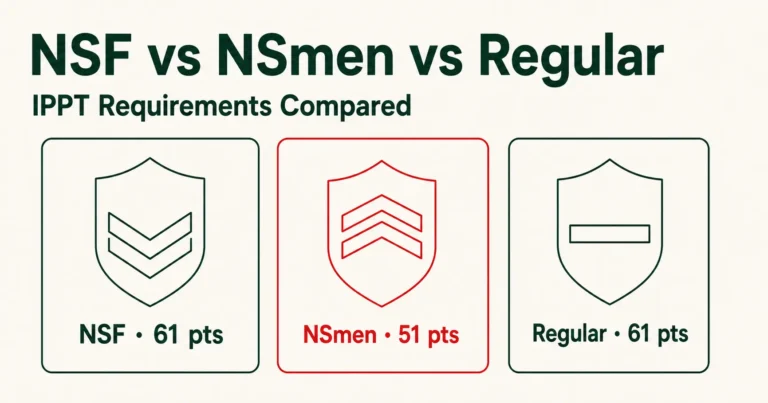
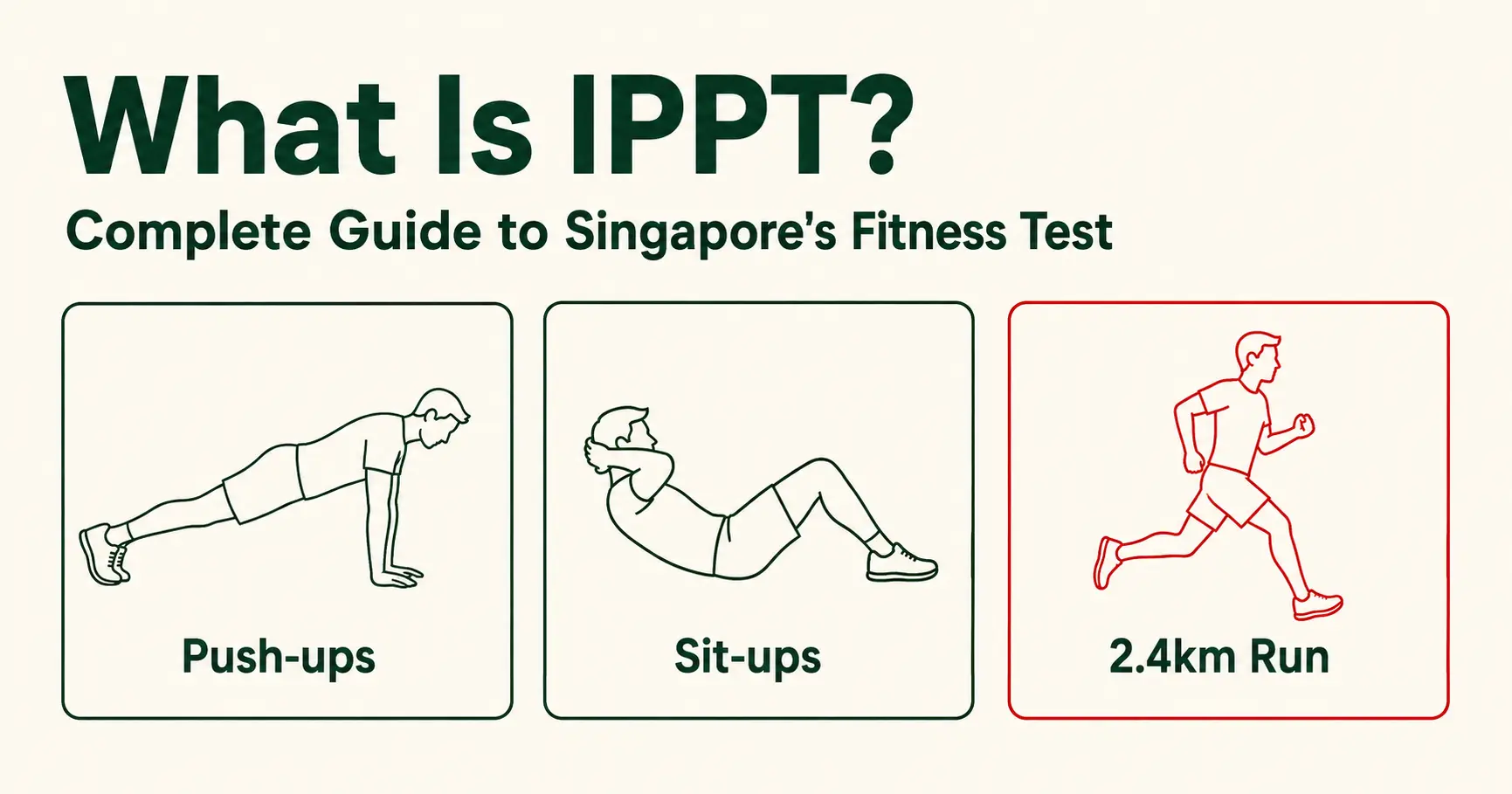
IPPT stands for Individual Physical Proficiency Test. It’s the mandatory fitness test the SAF, SPF, and SCDF use to check whether NSFs, NSmen, and Regulars are combat fit. The test has three stations: push-ups, sit-ups, and a 2.4km run, scored out of 100 points across 14 age bands. NSmen pass at 51 points. NSFs and Regulars pass at 61.
What Is IPPT and Who Needs to Take It?
IPPT is short for Individual Physical Proficiency Test. I’ve been coaching guys through this test for years, and the confusion almost always starts here: people think IPPT is one uniform standard, but it actually applies differently depending on who you are.
The test is used by three uniformed services to assess basic physical fitness and motor skills:
- Singapore Armed Forces (SAF), this guide’s primary focus
- Singapore Police Force (SPF), which runs its own IPPT-linked scheme via the MHA NS Portal
- Singapore Civil Defence Force (SCDF), also administered through the MHA NS Portal
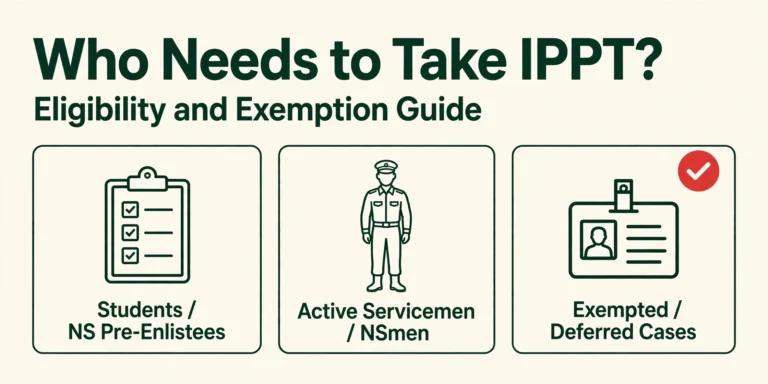
It’s mandatory for Full-Time National Servicemen (NSFs), Operationally Ready National Servicemen (NSmen, or reservists), and Regulars serving full careers in uniform. All male Singapore citizens and second-generation Permanent Residents aged 18 to 50 fall under this requirement, though some elite vocations cap the upper age closer to 40.
If you served in the Police or Civil Defence rather than the SAF, check the MHA NS Portal directly. The numbers in this guide are SAF-specific and shouldn’t be assumed to carry over one to one.
If you want the full breakdown of how NSF, NSmen, and Regular requirements compare side by side, I’ve covered that separately in the NSF vs NSmen vs Regular comparison.
What Are the 3 IPPT Stations and How Are They Scored?
The IPPT tests three things, worth up to 100 points combined:
| Station | Max Points | Duration |
|---|---|---|
| Push-ups | 25 | 1 minute |
| Sit-ups | 25 | 1 minute |
| 2.4km Run | 50 | Timed, no limit |
The run alone is half your total score. I always tell my trainees to stop neglecting it in favour of just grinding push-up reps.
Both the push-up and sit-up stations are electronically counted by a machine called ELISS. It only registers a rep when your arms fully straighten at the top of a push-up, or when your shoulder blades touch the mat on a sit-up. If your form breaks down even slightly, the rep doesn’t count. I’ve watched guys do 70 push-ups and walk away with only 50 counted because their elbows never fully locked out.
To pass, you need the minimum total score for your category plus at least 1 point in every single station. Score zero in any one station, even if your other two are strong, and you fail the whole test automatically. Every one of the 14 age bands has its own exact rep and timing thresholds, which I’ve laid out in full in the IPPT Age Group & Scoring Standards breakdown, so you can check precisely where you stand.
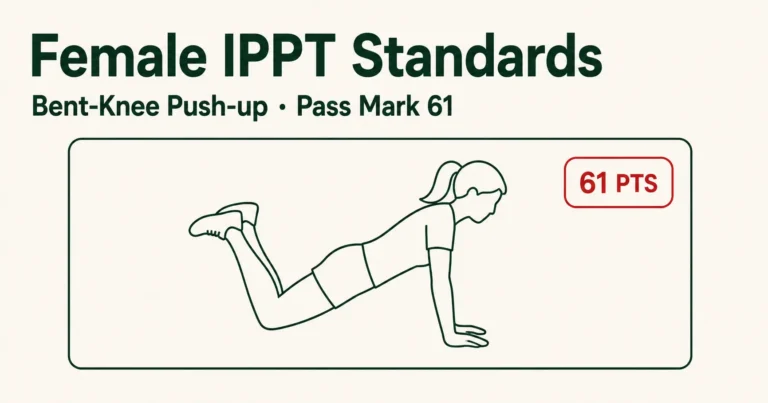
Women take the same three stations with a bent-knee push-up variant and separate scoring tables, covered in detail in the Female IPPT Standards guide.
Am I Eligible? PES Status and Exemptions
Your PES (Physical Employment Status) grade decides whether you take IPPT at all:
- PES A, B1: must attempt IPPT within your annual window, no station exemptions
- PES B2 (formerly called C1): must attempt IPPT but may be excused from up to 2 static stations
- PES B3, B4, C2 and below: exempt from the IPPT programme entirely
- Regulars graded PES C2: sit an Alternative Aerobic Fitness Test (AAFT) instead of standard IPPT
- Officers aged 45 and above, and WOSEs aged 40 and above: exempt by age
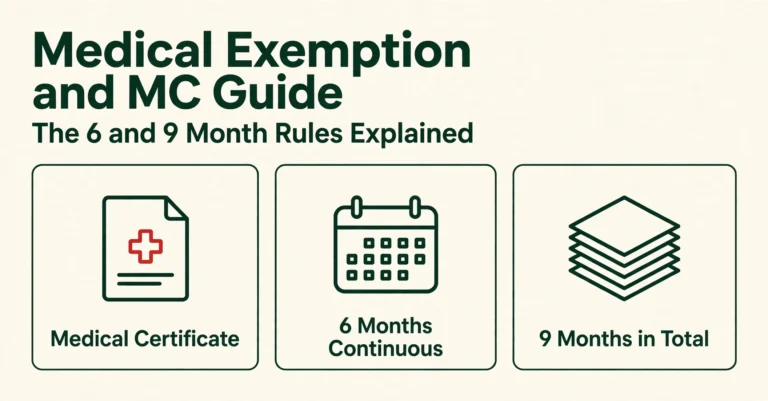
- Continuous medical exemption of 6 months or more, or cumulated 9 months or more, within your window: exempt
If your PES letter doesn’t match the clean picture most guides paint, that’s not an error on your part. Check your exact grading on OneNS rather than assuming.
What Is the IPPT Window and What Happens If I Default?
Your IPPT window is a rolling 12 month period that opens on your birthday and closes the day before your next one. You can attempt the test as many times as you like within that window. Score higher on a retest and your incentive tops up to match.
Overseas rules:
- Less than 12 months overseas: you’re still required to take IPPT; miss it and you’re marked a defaulter
- 12 months or longer overseas: apply for an Exit Permit on OneNS; once approved, it waives that window’s requirement
Defaulting means no attempt at all during your 12 month window with no qualifying exemption. It’s handled on a graduated disciplinary scale depending on your circumstances and service record. A genuine, properly documented medical or work situation is treated very differently from simply ignoring the requirement. My advice to every trainee is simple: don’t let a missed booking turn into a defaulted window. If you want your own dates worked out in full, our IPPT window guide shows how to count your exact start and end dates, how the Home Team financial year window differs, and what happens step by step when a window closes with no attempt.
Where Can I Take IPPT? FCC vs SAFRA
As of October 2025, the active NSmen FCCs are:
- Bedok FCC
- Khatib FCC
- Kranji FCC
- CMPB FCC at 91 Hillview Link, opposite Cashew MRT: a new integrated hub opened October 2025 with a sheltered running track
Maju FCC is no longer used for NSmen IPPT or NS FIT. Double-check the current list on OneNS before you book out of habit.
Once you have picked a centre, follow the steps to book IPPT on OneNS, including how far ahead you can book, morning and afternoon closing times, and how to reschedule or cancel.
You can also test at SAFRA EnergyOne Gyms in Jurong, Punggol, Tampines, and Toa Payoh, where the 2.4km run happens on a calibrated indoor treadmill. Here’s the catch first-timers miss: SAFRA sessions give you a pass or fail result only, with no monetary award. Chasing the cash incentive means testing at an FCC.
What Cash Incentives Can I Earn?
The current award bands (Gold 85 and above, Silver 75 to 84, Pass with Incentive 61 to 74) have applied since 1 April 2015. The cash amounts of $500, $300 and $200 date from 2014. They are separate from the one-off NS55 payments some guys confuse them with. NSmen incentives are credited via bank or PayNow within about 14 days. NSmen and Regulars receive theirs through their monthly salary instead.
| Award | Points Needed | Cash Incentive | Notes |
|---|---|---|---|
| Pass | 51 to 60 for NSmen; 61 for NSF/Regular (no separate band) | $0 | No cash for a plain Pass |
| Pass with Incentive | 61 to 74 | $200 | First cash tier |
| Silver | 75 to 84 | $300 | Silver IPPT badge awarded |
| Gold | 85 to 100 (90+ for Commando/Guards/Diver) | $500 | Gold IPPT badge awarded |
Singapore’s Ministry of Defence confirmed in a March 2026 written Parliamentary reply that the IPPT passing rate for NSmen has stayed stable over the past 10 years and is broadly similar across all age groups, proof that the age-banded scoring genuinely levels the playing field.
If you’re checking exactly how many reps or what run time you need for your own age and target award, run your numbers through the IPPT Calculator for an instant result.
How Did IPPT Change From 5 Stations to 3?
I remember training guys through the 2015 transition. Morale genuinely lifted once chin-ups were off the table, since that station had quietly wrecked more IPPT attempts than any other.
| Year | What Changed |
|---|---|
| 1967 | NS begins. The fitness test is a 4.8km run with a 30 minute limit, plus a 9.6km route march within 70 minutes in full battle order. |
| 1979 | Replaced by a 5 station IPPT: push up, sit up, chin up, half knee bend, and the 2.4km run. |
| 2015 | Simplified to the current 3 station format of push up, sit up, and run. Age bands shortened from 5 year to 3 year blocks. |
| Oct 2025 | The new CMPB opens as an integrated FCC at 91 Hillview Link. Maju FCC is discontinued for NSmen IPPT and NS FIT. |
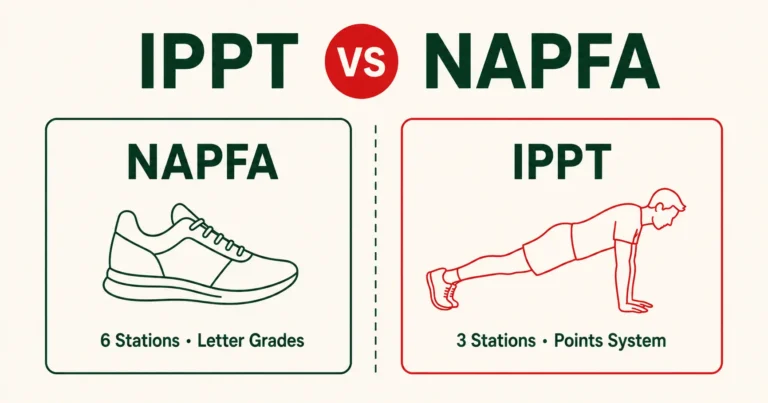
This same era also brought a shift in how school-leavers first meet IPPT-style testing. If you’ve come here straight from Secondary school or JC and you’re not sure how what you did in PE class connects to this test, the IPPT vs NAPFA comparison clears that up.
What Happens If You Fail IPPT?
A fail means no award and, for most NSmen, a placement into NS FIT, the fitness improvement programme that replaced the old Remedial Training system in April 2021. There’s no cash fine for failing, provided you complete your sessions. The full breakdown of what NS FIT involves and how the retest process works is covered in our guide to IPPT fail consequences and next steps.
Frequently Asked Questions
Adrian Tan – IPPT Trainer & Fitness Content Specialist